

































































GF Wiki
Expected Points (xPts): how many points a team deserved
Expected points estimate how many points a team deserved from a match, based on the quality of the chances both sides created rather than the final score.
In short
- xPts starts from each side's expected goals (xG) in a match.
- A Poisson model turns those into the chance of a win, a draw and a loss.
xPts = 3 × win chance + 1 × draw chance, so a single match is worth between 0 and 3 xPts.
Why expected points?
Football results are noisy. A team can dominate a match, create the better chances and still lose 1–0 to a deflected shot. Over a few weeks that luck evens out, but a league table built only on points can hide it for a long time.
Expected points look past the scoreline. They ask: given the chances each team actually created, how many points would this performance usually earn? A side that keeps creating good chances will collect plenty of xPts even during a run of bad results, and a side that keeps winning narrow games on very little will show fewer xPts than real points.
How it's calculated
We work out xPts for every match in three steps.
- Start with expected goals. For each match we take the team's expected goals (xG) and the opponent's xG, which is the team's expected goals against (xGA). xG measures the quality of the chances a team had: a tap-in from two yards is worth far more than a shot from 35 metres.
- Turn xG into scorelines. We treat each team's goals as a Poisson distribution whose average is its xG, and assume the two teams score independently. That gives a probability for every scoreline from 0–0 up to 6–6. Scorelines beyond six goals for one side are so unlikely that we leave them out.
- Add up wins, draws and losses. Every scoreline where the team scores more is a win, equal scores are a draw, and the rest are losses. Adding those probabilities gives the team's chance of each result.
xPts = (win probability × 3) + (draw probability × 1)
A worked example
Say the home side finishes a match with 1.8 xG and the away side with 0.9 xG. The grid below shows how likely every scoreline was given those chances.
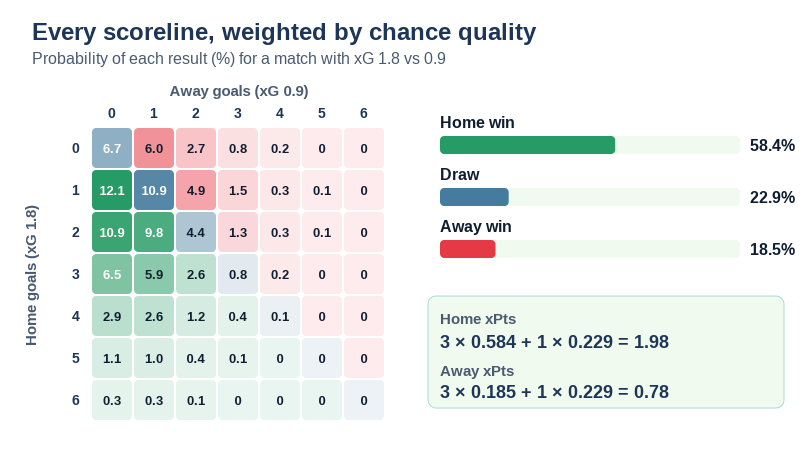
Adding up the green cells gives the home side a 58.4% chance of winning, the blue cells a 22.9% chance of a draw, and the red cells an 18.5% chance of losing.
| Win | Draw | Loss | xPts | |
|---|---|---|---|---|
| Home (1.8 xG) | 58.4% | 22.9% | 18.5% | 1.98 |
| Away (0.9 xG) | 18.5% | 22.9% | 58.4% | 0.78 |
So whatever the actual score was, the home side "deserved" about two points from this match and the away side a little under one.
Season and recent totals
A team's xPts over a season, or over its last five matches, is simply the sum of its xPts from each of those matches. Comparing that total with the team's real points shows who is over- or under-performing:
- Points well above xPts: the team is winning more than its chances suggest. That can be clinical finishing or an excellent goalkeeper, but it is often good fortune that does not last.
- Points well below xPts: the team is playing better than its results. These sides often climb the table once their luck turns.
Where you'll see it on the site
League tables on the home page and on every league page show an xPts column next to the real points. Tables are still ranked by real points: xPts sits alongside them as a measure of performance, not as a different ranking.
Good to know
Why do the two teams' xPts not add up to 3?
A win hands out 3 points in total, but a draw only hands out 2. Because every match has some chance of a draw, the two sides' xPts together are always a little under 3.
Is xPts a prediction?
No. It is calculated after the match from the chances that were actually created. It describes how well a team played, not what will happen next time.
What happens when a team has almost no xG?
We use a minimum of 0.05 xG per team, so a side that barely threatened still has a very small chance of scoring in the model.