

































































GF Wiki
Player positions: how we work out where a player plays
A player's positions come from where they actually started matches, not from a fixed label. We read every starting lineup and weight recent seasons more heavily.
In short
- Every start is assigned one of 14 roles from the team's formation and the order of the starting eleven.
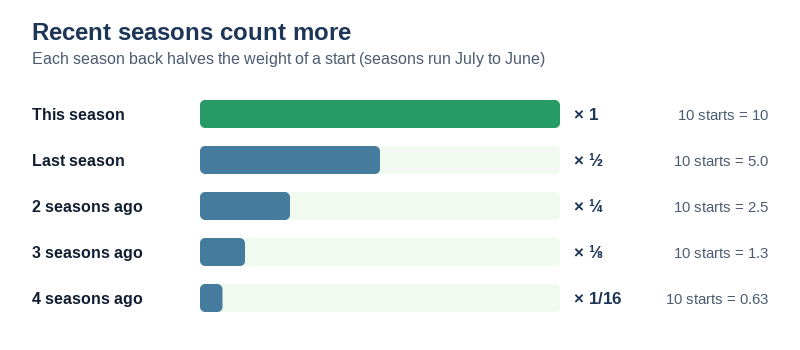
- Starts this season count in full; each season further back counts half as much.
- The most-played role is the main position. Others become secondary positions with at least 10% of weighted starts and 3 real starts.
From lineups to roles
For every match with a lineup, we take each team's formation (4-3-3, 3-5-2 and so on) and the order of the starting eleven on the pitch. From those two things we can assign every starter a specific role, such as right back, defensive midfielder or left winger.
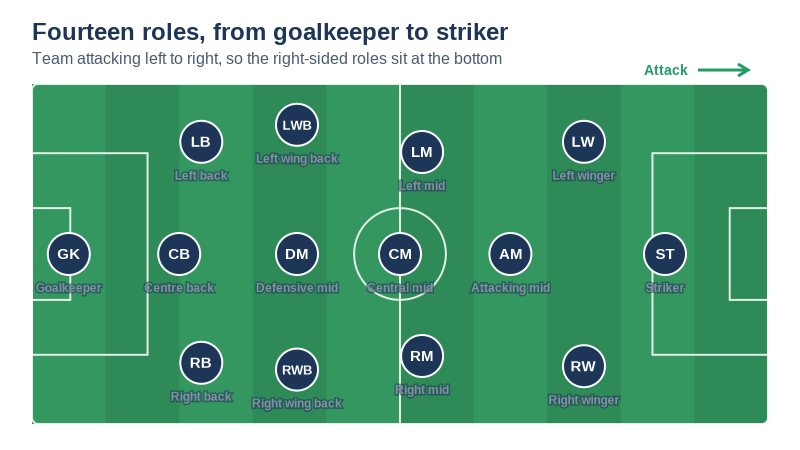
A few rules keep the data clean:
- Only starts count. Substitute appearances are left out, because a player coming on often slots into whatever gap is free.
- Doubtful lineups are skipped, not guessed. If a lineup is incomplete, has no formation, or uses a formation we don't recognise, we leave it out. One missing player would shift everyone after them into the wrong role.
- Club and country count the same. A start for a national team counts just like a start for a club.
Recent seasons count more
Players change position over a career: a winger becomes a wing back, a number 10 drops deeper. To keep positions current, every start is weighted by how recent its season is. Seasons run from July to June.
Main and secondary positions
- Main position
- The role with the most weighted starts. If two roles are level, the one with more actual starts wins.
- Secondary positions
- Any other role with at least 10% of the player's weighted starts and at least 3 actual starts. Both conditions must hold, so a single emergency start in an unfamiliar role doesn't count.
Example
A midfielder made 20 starts at central midfield this season and 4 at defensive midfield. Last season they made 16 starts at defensive midfield.
| Role | Real starts | Weighted starts | Share |
|---|---|---|---|
| CM | 20 | 20 | 62.5% |
| DM | 20 | 4 + 8 = 12 | 37.5% |
Both roles have 20 real starts, but CM leads on weighted starts, so CM is the main position and DM is a secondary position.
Reading a player's page
The Positions table on a player page lists the main role and any secondary roles:
- Starts is the real number of starts in that role, across all seasons.
- Share is the role's share of the weighted starts. Because it leans towards the current season, it need not match the raw start counts.
On the pitch graphic, the main position is the red dot and secondary positions are blue, fading the less often the role is played.
Players without usable lineups
New signings and players whose matches have no detailed lineup show the position listed by our data source instead. That may be a general label such as MF rather than a specific role, and it has no starts or share. Positions are recalculated shortly after new results come in, so these players get proper roles once they start matches with a lineup.
Where you'll see it on the site
The same main and secondary positions fill the Pos and SecPos columns in player tables, such as Top Players. The position filter in those tables matches any of a player's regular positions, main or secondary. See Abbreviations for every role code.